Tell us about the job
Takes about a minute. No obligation.
A contractor quoting a boiler repair in Franklin County starts with the burner and ignition system, and for good reason. Homes in Franklin County, VT run heat about nine months a year, from September through May. That kind of sustained cycling loads the igniter, the burner assembly, and the circulator pump far harder than the heat exchanger, which is built to outlast them. When a boiler stops firing or starts short-cycling, those components are where a contractor looks before pulling anything apart. The heat exchanger gets opened later, only if the initial check leaves the cause unsettled.
Piping runs, zone controls, and expansion tanks in older houses often outlast the boilers they were installed alongside, and when a boiler fails, what a contractor finds behind the unit can redirect the whole repair. Half the homes in Franklin County, Vermont were built in 1979 or earlier (2020-2024 ACS 5-year). Stock that old was heated by systems whose supporting infrastructure may have never been touched since the original install. A contractor opening a boiler here checks whether the relief valve, the circulator, and the distribution piping are still serviceable, because a failed boiler sometimes turns out to be the last item on a longer list.
The Parts of a Boiler a Contractor Checks During Repair
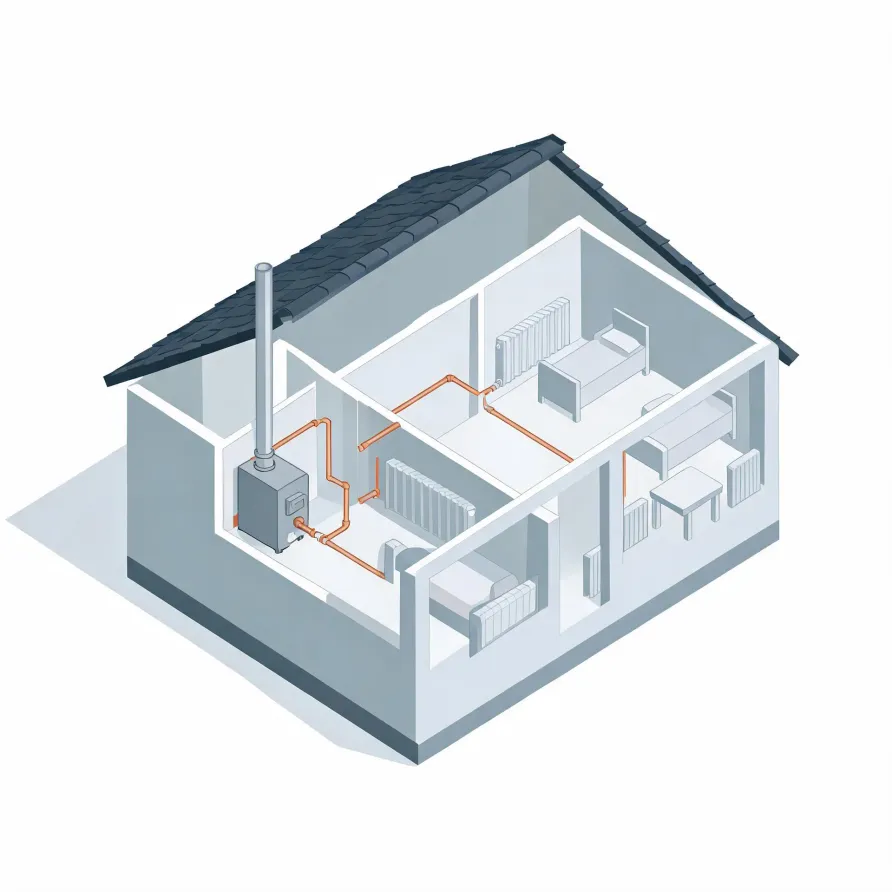
The boiler itself sits in the basement or mechanical room and is the piece a contractor reaches first. It houses the burner, the heat exchanger, and the controls that tell the whole system what to do. When heat stops, runs short, or behaves unevenly, those internal components are where the diagnosis begins.
Running out from the boiler, the supply and return pipes carry hot water to the radiators or baseboard units in each room and bring cooled water back. The circulator pump, mounted on the return line, keeps that water moving. The expansion tank, pressure relief valve, and aquastat round out what a contractor examines when a problem points away from the boiler itself.
The drawing shows a representative layout, and a licensed contractor determines which components apply to your specific system and what repair each one needs.
Find a contractor in Franklin CountyFranklin County, Vermont, by the numbers
128 severe weather events were recorded in Franklin County, Vermont between 2015 and 2024.
NOAA National Centers for Environmental Information, Storm Events Database, bulk CSV export, events 2015-01-01 through 2024-12-31.Half the homes in Franklin County, Vermont were built in 1979 or earlier (2020-2024 ACS 5-year).
U.S. Census Bureau, 2020-2024 American Community Survey 5-Year EstimatesFranklin County, Vermont holds 23,019 housing units (2020-2024 ACS 5-year).
U.S. Census Bureau, 2020-2024 American Community Survey 5-Year EstimatesOwners occupy 77.4% of the occupied homes in Franklin County, Vermont (2020-2024 ACS 5-year).
U.S. Census Bureau, 2020-2024 American Community Survey 5-Year EstimatesBoiler Repair Rules & Standards for Franklin County, Vermont2 sourced rules and standards
What Franklin County, Vermont Requires for This Work
Vermont splits the trade across two specialty licences and a contractor may hold one without the other: field A1 covers automatic gas or oil heating including geo-thermal and ground source heat pumps, and field C3 covers refrigeration or air conditioning including air-to-air heat pumps.
Vermont reaches HVAC work through its electricians’ licence rather than an HVAC licence, and the requirement stops at the front door of a house: anyone performing electrical work in Vermont must be licensed as an electrician unless the work is in a residential building containing two or fewer dwelling units.
Severe Weather Events in Franklin County
Boilers in Franklin County work against whatever the weather delivers, and hard weather accelerates wear on heat exchangers, pressure relief valves, and expansion tanks. How often severe conditions hit here shapes how much stress local boilers carry between service calls.
128 severe weather events, 2015–2024. Source: NOAA National Centers for Environmental Information, Storm Events Database.