Tell us about the job
Takes about a minute. No obligation.
A contractor called out to repair a boiler in Bennington County starts at the ignition system and the burner before anything else. Homes in Bennington County, VT run heat about nine months a year, from September through May. That cycling load falls hardest on the parts that fire the boiler each time a thermostat call comes in: the igniter, the flame sensor, and the gas valve wear against every start, not against the hours the boiler simply holds steady. The heat exchanger and the pressure vessel matter, but they accumulate wear more slowly. A repair quote that opens with the ignition components is reading what the season has already done to the machine.
Boilers in older housing sit at the end of a long chain of prior decisions: pipe runs, zone valves, and expansion tanks that were specified for systems no longer in the house. Half the homes in Bennington County, Vermont were built in 1972 or earlier (2020-2024 ACS 5-year). A contractor opening a boiler here finds the unit itself, then finds what feeds and follows it. If a zone is not responding, the answer may be in the valve, the circulator, or a section of pipe that was modified when the previous system came out. The boiler is where repair starts, and the distribution loop is where it often ends.
The Parts of a Boiler a Contractor Checks During Repair
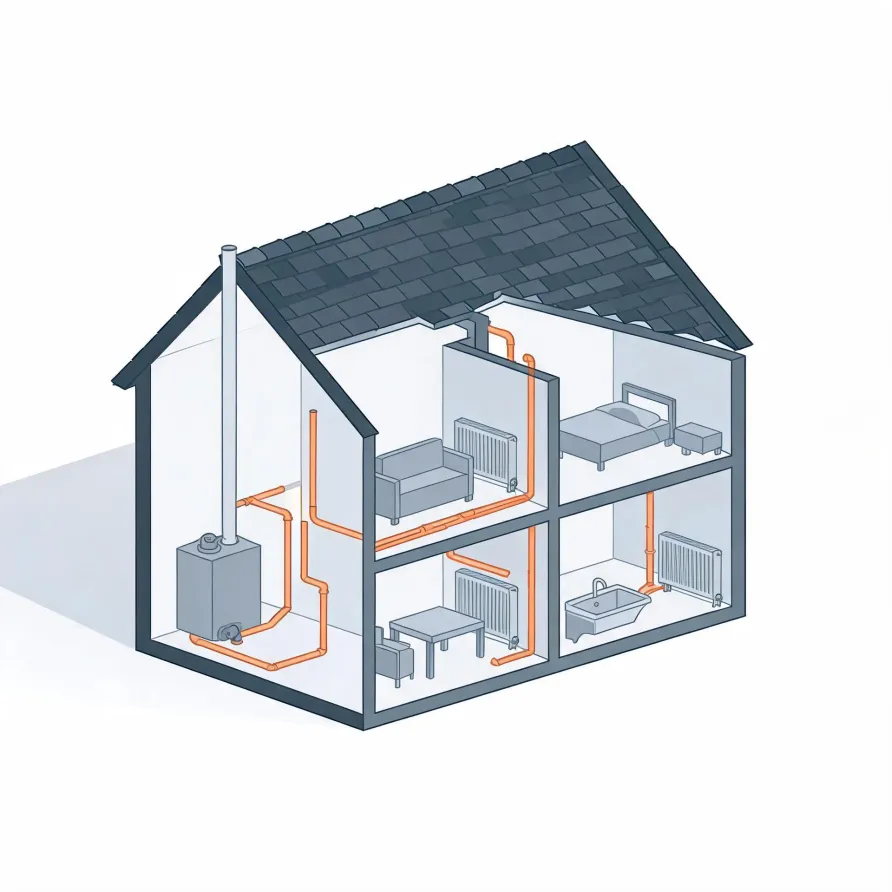
The boiler itself sits in the basement or a mechanical room and is the piece a contractor reaches first. It houses the burner, the heat exchanger, and the controls that govern how the system runs. When the house stops heating, one of those internal components is usually where the fault lives.
Radiators or baseboard units sit in the living spaces and are what the homeowner feels when something is wrong. Connecting them to the boiler are supply and return pipes, along with a circulator pump that moves hot water through the loop. The expansion tank, pressure relief valve, and aquastat are smaller components that a contractor checks because each one can quietly knock the whole system off.
The drawing shows a typical boiler layout, and a licensed contractor will determine which components apply to your specific home and situation.
Find a contractor in Bennington CountyBennington County, by the numbers
165 severe weather events were recorded in Bennington County, Vermont between 2015 and 2024.
NOAA National Centers for Environmental Information, Storm Events Database, bulk CSV export, events 2015-01-01 through 2024-12-31.Half the homes in Bennington County, Vermont were built in 1972 or earlier (2020-2024 ACS 5-year).
U.S. Census Bureau, 2020-2024 American Community Survey 5-Year EstimatesBennington County, Vermont holds 20,903 housing units (2020-2024 ACS 5-year).
U.S. Census Bureau, 2020-2024 American Community Survey 5-Year EstimatesOwners occupy 73.7% of the occupied homes in Bennington County, Vermont (2020-2024 ACS 5-year).
U.S. Census Bureau, 2020-2024 American Community Survey 5-Year EstimatesBoiler Repair Rules & Standards for Bennington County, Vermont2 sourced regulations and codes
Licensing Rules for HVAC Repair in Bennington County, Vermont
Vermont splits the trade across two specialty licences and a contractor may hold one without the other: field A1 covers automatic gas or oil heating including geo-thermal and ground source heat pumps, and field C3 covers refrigeration or air conditioning including air-to-air heat pumps.
Vermont reaches HVAC work through its electricians’ licence rather than an HVAC licence, and the requirement stops at the front door of a house: anyone performing electrical work in Vermont must be licensed as an electrician unless the work is in a residential building containing two or fewer dwelling units.
Severe Weather Events in Bennington County, Vermont
Harsh weather puts real strain on boilers, pushing them to run harder and longer than they would under mild conditions. How often that pressure hits in Bennington County shapes how much wear local equipment takes and how soon problems show up.
165 severe weather events, 2015–2024. Source: NOAA National Centers for Environmental Information, Storm Events Database.